
Two Worlds Not So Far Apart - Shinnecock & Doonbeg, The Links Take Centre Stage
Golf Tourism · Commercial Strategy · Geopolitics
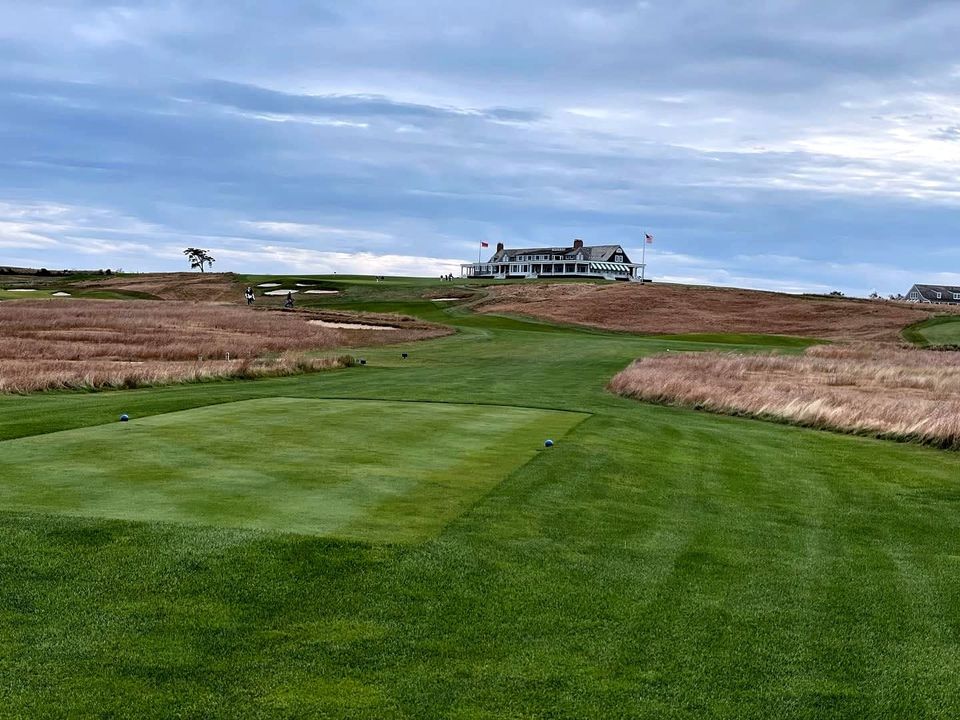
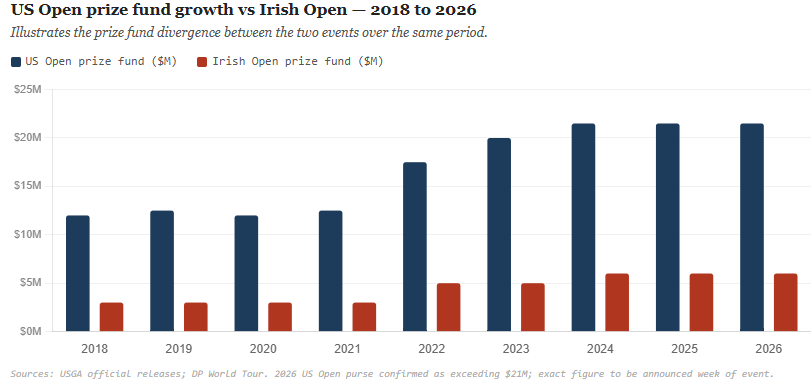
Shinnecock Hills and Doonbeg sit on opposite sides of the Atlantic, separated by 5,000 miles and a $15.5 million prize fund gap. In 2026, both will host professional golf at the same moment in history, and the commercial decisions each has made reveal more about the sport’s future than the leaderboards will.
The 2026 US Open at Shinnecock Hills carries a prize fund in excess of $21 million, an economic impact estimated at $200 million across eastern Long Island, and the weight of a championship that has been played at the same venue since 1896. The 2026 Amgen Irish Open at Trump International Golf Links Doonbeg carries a $6 million prize fund, an anticipated economic impact of tens of millions of euro for West Clare, and the complication of a sitting US president who owns the course and is earmarked to attend.
They are separated by an ocean, a currency, and a prize fund differential of $15 million. They are connected by something less obvious: both are negotiating, in real time, the same fundamental tension between what a golf tournament can extract from its surroundings and what it owes them in return. One has decided to take less. The other is hoping to maximise everything it can. Both decisions are commercially rational. Both carry risks the other does not.
The contrast deserves examination not as a curiosity but as a case study in how professional golf’s commercial logic plays out differently depending on geography, ownership, and the particular pressures a venue faces in 2026.
Shinnecock: the deliberate art of doing less
The 2018 US Open at Shinnecock Hills was not, by any measure, a success on the course. Wind rendered the greens nearly unplayable on Saturday afternoon, with the USGA forced to water them mid-round in an intervention that drew widespread criticism. The course took years to recover. Attendance that week ran to approximately 180,000; north of the figure the club’s president later described as sustainable for the surrounding Southampton community.
The conversations that followed shaped everything about the 2026 edition. The club, as Shinnecock president Mark Pickett has described publicly, sat down with the USGA and asked for less. Fewer tickets. Less build-out. Smaller infrastructure footprint. Less traffic on the single road connecting the course to the rest of the Hamptons, where shuttle buses carrying staff and volunteers were caught in jams lasting hours on the first days of the 2018 event.
The result is a US Open that has, by design, left money on the table. Daily attendance at Shinnecock in 2018 ran to north of 180,000 for six days of ticketed access. The 2025 US Open at Oakmont drew an estimated 295,000 across the week. Shinnecock 2026 will be substantially smaller than either. Tickets are currently reselling on the secondary market at approximately $1,800, not because demand is low, but because supply has been deliberately constrained.
The USGA’s stated rationale is environmental and community-focused: protecting a course that history has already claimed as its own, and reducing the disruption to a village whose roads and infrastructure were not built for the scale of a modern major championship. The subtext is commercial sustainability. A Shinnecock that takes years to recover from each US Open visit is less valuable as a long-term asset than one that hosts sustainably every decade. The USGA is, in effect, accepting a short-term revenue reduction in exchange for long-term course preservation.
Doonbeg: the maximisation problem
Doonbeg is a small coastal village in County Clare. According to local accounts, more than half the parish is employed by or connected to Trump International Golf Links, which has been a major economic driver for West Clare since the course opened. The Irish Open arriving in September is not, for this community, a sporting event with economic spillover. It is the economic event of the year, full stop.
The commercial stakes are significant. The 2023 Horizon Irish Open at the K Club attracted over 130,000 spectators and generated an estimated €24 million in direct economic impact, with an additional 400 million households worldwide reached via broadcast. The DP World Tour’s own two-year average for Irish Open economic impact is €16 million. Clare Chamber of Commerce has described the potential as “tens of millions of euro” in visitor spend, with local hotels already reporting early interest from international travel operators packaging golf trips around the event.
The challenge is structural. Doonbeg sits roughly an hour from Shannon Airport on roads that were not designed for major championship traffic. One road in, one road out. The maximisation imperative (the desire to extract maximum economic value from a once-in-a-generation event) runs directly into the physical constraints of a village of 600 people and a coastline subject to environmental protections that limit what can be built on and around the course.
There is also the matter of the owner. Trump is earmarked to attend the event, with the resort’s managing director describing him as “likely” to be on site at some stage during the week. US-based golfers were paying €25,000 per head to join Doonbeg in record numbers following Trump’s election, with the resort recording its highest ever number of new membership sales in January 2025. The Irish Open at Doonbeg is simultaneously a DP World Tour Rolex Series event, a golf tourism catalyst for the Wild Atlantic Way, and a commercial asset for a US president’s privately-held property portfolio. Those three things are not in direct conflict. They are not entirely compatible either.
“Doonbeg’s machine does not run on broadcast rights or sponsorship decks. It runs on people arriving from Boston and New York, staying four nights, and telling their friends.”
The economics of restraint versus maximisation
The financial architecture of the two events illustrates the divergence precisely. Shinnecock operates at the top of the commercial hierarchy ($21 million prize fund, $200 million economic impact, broadcast rights, global sponsorship) and has chosen to constrain the attendance product that sits beneath all of it. The USGA is protecting the asset. Doonbeg operates with a fraction of those commercial inputs and is doing the reverse: maximising the attendance and tourism product because that is where its economic value actually sits.
The Golf Ireland Economic Impact Report (2025) recorded €717 million in direct economic value and 15,600 jobs supported across the island from golf tourism, with 80 percent of tourist spend falling outside golf activity entirely. The Irish Open at Doonbeg sits within that ecosystem as a catalyst event: it does not just generate revenue during tournament week, it draws the attention of international golf tourists to a stretch of coastline that also includes Lahinch, Ballybunion, Waterville, and the courses of Kerry. The broadcast reach — the K Club 2023 edition reached an estimated 400 million households — functions as a promotional vehicle for a tourism product that extends well beyond the ropes.
Shinnecock operates differently. The Hamptons do not need a golf tournament to attract wealthy visitors. The economic impact is real and welcome, but it is additive rather than foundational. The USGA’s decision to constrain attendance reflects the fact that Shinnecock’s value is not primarily economic. It is reputational, historical, and architectural. Protecting the course matters more than filling it, because the course is the asset.
The Trump variable
The decision to award the 2026 Irish Open to Trump International Doonbeg was made by the DP World Tour against a backdrop of political controversy that the Tour’s commercial logic overrode. Doonbeg is a genuine world-class links course. Its Greg Norman design along a protected stretch of Clare’s coastline is widely admired. The tourism case for bringing the Irish Open to the Wild Atlantic Way, one week before the BMW PGA Championship at Wentworth, in a late-season slot that suits Race to Dubai contenders, writes itself.
The complication is inseparable from the opportunity. Every broadcast image of Doonbeg in September 2026 is simultaneously a broadcast image of a Trump-branded property. Every reference to the Irish Open’s host venue is a reference to the sitting US president’s business interests. Trump-owned courses have staged events in Scotland and the United States, as Trump National Doral returned to the PGA Tour calendar in 2026 after a ten-year absence, and the pattern is consistent: commercial golf is accommodating the Trump portfolio at a moment when it has few alternative major championship venues capable of hosting at this level.
Whether that creates reputational risk for the DP World Tour, or whether it is simply a pragmatic commercial decision that separates venue quality from ownership politics, depends on a question the Tour has not publicly addressed: at what point does the identity of the owner become inseparable from the identity of the event? Shinnecock Hills is owned by its members. The US Open’s brand is the USGA’s brand. Doonbeg belongs, in a meaningful commercial sense, to someone who is simultaneously the most politically polarising figure on the planet. That is not a reason to refuse the venue. It is a variable that any honest commercial analysis of the 2026 Irish Open is required to account for.
Two Atlantic coastlines, one question
Shinnecock and Doonbeg are, in the end, answering the same question from opposite ends of the commercial spectrum. How much can a golf tournament take from the place it visits, and how much must it leave behind?
Shinnecock has decided the answer is: less than you might think. A course with six US Open appearances dating to 1896 and a community that explicitly asked for a smaller event is worth protecting from its own commercial potential. The USGA has accepted that constraint and structured its 2026 edition around it.
Doonbeg has decided the answer is: as much as it can responsibly absorb. A village of 600 people with a structural economic dependency on its golf resort, a once-in-a-generation event, and a coastline that the global golf tourism market is only beginning to discover is not in a position to leave value on the table. The maximisation imperative is not greed. It is an economic necessity dressed in links grass and Atlantic wind.
Both answers are correct for their circumstances. Both carry consequences. Shinnecock trades short-term revenue for long-term asset preservation. Doonbeg trades political complexity for economic impact that its community cannot afford to decline.
New York minimising. County Clare maximising. Éamon de Valera, the American born long-serving Irish Taoiseach who spent his political life bridging his two hearts. The world he imagined, self-sufficient, Atlantic-facing, valued on its own terms, is not quite what Doonbeg represents. But a stretch of Clare coastline commanding the attention of global capital and American presidents is not nothing either.
Neither is purely a golf story. Both are finance stories that happen to be told on a fairway.
Fairway Economics will be watching.
Prize fund data from USGA and DP World Tour official sources. Economic impact figures from Sport for Business, DP World Tour, Golf Ireland Economic Impact Report (2025), Clare Chamber of Commerce. Attendance data from 27East.com and USGA. Trump Doonbeg financial data from RTE/Companies House filings. Shinnecock community engagement detail from USGA official release.
Photos: Jon Cavalier (LinksGems), Dave (@GolfingKorea)
Next: the 2027 Ryder Cup at Adare Manor; €499 a day, and who that pricing is really designed for.
Member discussion